

When the Fifth Season Arrives
Wildfire season: what every homeowner — and buyer — needs to know
Ask anyone who’s lived in the Columbia Valley for a few summers and they’ll tell you the same thing: British Columbia now has a fifth season. Spring, summer, fall, winter — and wildfire season. It’s part of mountain life, and like everything else about living here, it’s manageable when you understand it and plan ahead. There are two sides to that coin: the risk buyers need to know about before they’re in the middle of a summer purchase, and the practical steps every homeowner can take right now.
The buying risk nobody talks about
Summer purchases come with a risk that can quietly kill a deal mid-stream, and most buyers don’t hear about it until they’re already in it. Here’s the chain: your lender won’t advance your mortgage without proof of home insurance, and when a wildfire is burning in the area, insurers will often decline to bind a new policy on a home near the fire. No insurance means no mortgage, which means no closing. That’s exactly the kind of thing you want to know before you write an offer, not after.
The good news is that it’s very manageable when you plan for it. Here’s how I protect my buyers:
Line up insurance early — and get a binding commitment, not just a quote. A quote is a price; a bound policy is the insurer actually agreeing to cover you as of your closing date. Only one of those gets you to the finish line.
Build in a “subject to insurance” condition. This protects you if coverage can’t be secured in time, rather than leaving you on the hook.
Know about the wildfire clause. BC has an optional contract clause that allows for an extension of the completion, adjustment, and possession dates if a wildfire is genuinely preventing you from getting insurance (and therefore financing). We’d discuss whether it fits your situation.
Ask about “stay on risk.” In some cases the seller’s existing insurer will temporarily reissue their policy in your name to bridge a closing that lands during a threat. It’s not always available, but it’s worth exploring.
Consider timing and your rate hold. A fall completion sidesteps peak fire risk entirely — and if we do need an extension, remember mortgage rate holds don’t last indefinitely, so we’d loop in your broker early.
Anything touching contract clauses and financing timelines is worth a quick word with your lawyer, insurance broker, and mortgage broker too — I coordinate all of it so nothing falls through the cracks.
What you can do right now as a homeowner – FireSmart
If you already own here, the single best thing you can do is make your home more resilient before a fire ever threatens it — and there’s real support to help you do it.
Homeowners in Rural Golden (Electoral Area A) can book a free FireSmart home assessment. A trained local FireSmart representative walks your property with you and points out the specific things that raise your risk — the wood pile against the deck, the cedar hedge hugging the siding, the needles in the gutters, the branches overhanging the roof. It’s practical, property-specific, and there’s no cost.
There’s also newer support worth knowing about: through the Columbia Basin Wildfire Resiliency Initiative — a partnership between the Province of BC and Columbia Basin Trust — Rural Golden and Rural Revelstoke are piloting an expanded FireSmart assessment and rebate program aimed at helping vulnerable residents get mitigation work done. If you or someone you love is a senior, has a disability or mobility challenges, or is on a limited income, this can make the difference between a good plan on paper and work that actually gets completed. In Rural Golden, eligibility runs through the local Better at Home program — you can reach them at goldenbetterathome@gmail.com to ask whether you qualify.
Live inside Golden town limits rather than the rural area? The Town of Golden runs its own FireSmart program too, so it’s worth checking what assessments and support are available to you directly.
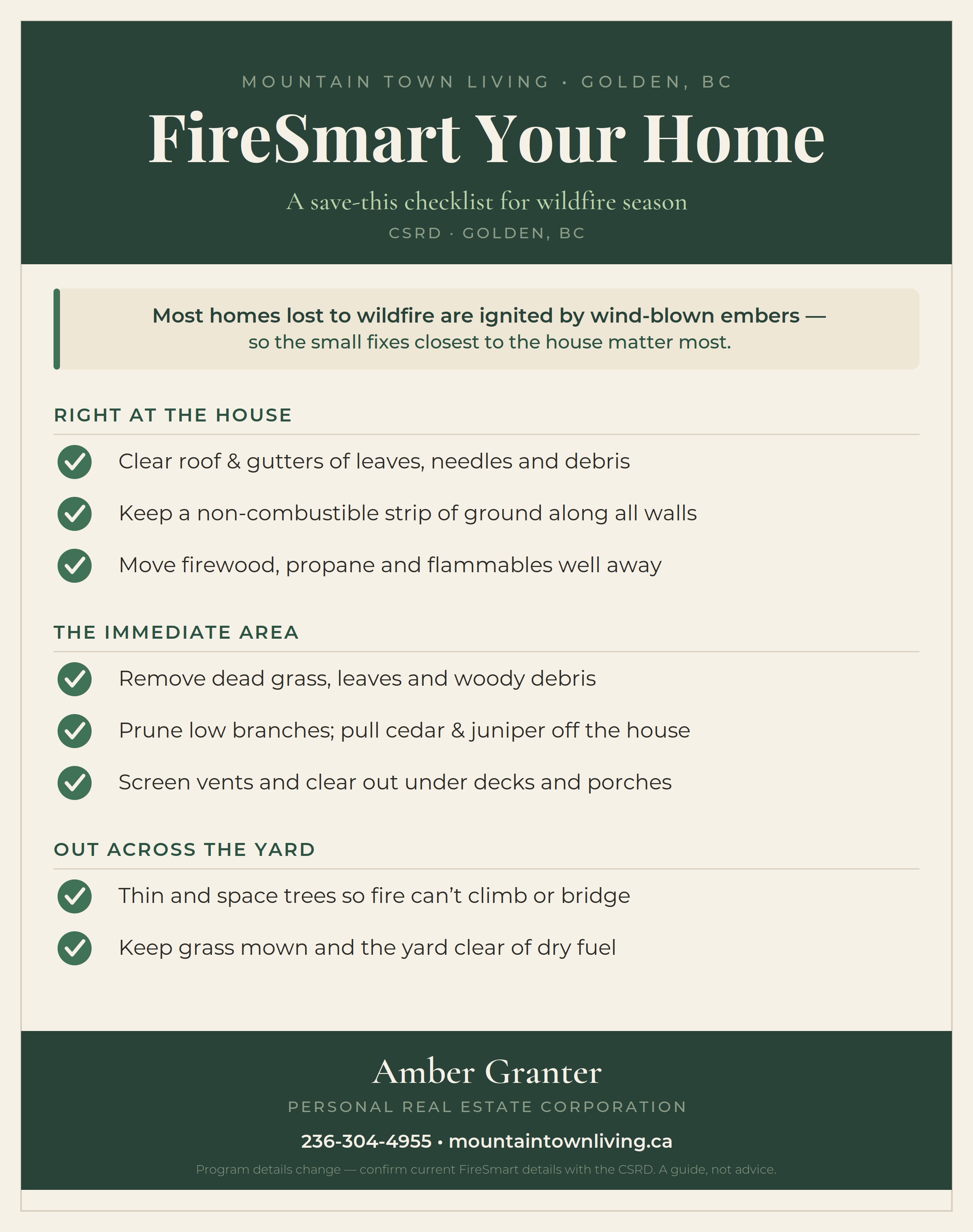
A few more things worth knowing:
Most of what makes the biggest difference happens right around your home — clearing combustible material away from the walls, keeping a non-combustible zone along the foundation, and removing the easy fuel that embers love. The majority of homes lost in a wildfire are ignited by wind-blown embers, not the wall of flame itself, so these small changes matter more than they look.
Your assessment is yours. The program is educational — the CSRD doesn’t report your score or property details to insurance companies. It’s there to help you, full stop.
Bonus: CSRD landfills (including Golden) take small loads of yard and garden waste for free with a FireSmart declaration form, which makes clearing that brush a lot easier on the wallet.
Beyond the resilience itself, this work increasingly pays off at insurance time too. Some insurers offer perks for completing a wildfire mitigation assessment, and being FireSmart is becoming part of how homes in interface areas stay affordable to insure.
Selling this summer? This matters to you as well.
If you’re counting on the proceeds of your sale to fund your next purchase, a buyer’s insurance delay can ripple straight into your plans. Having your home already FireSmart and your own insurance details handy makes your property easier to transact — and a little more reassuring to a nervous buyer.
Wildfire season is simply part of the rhythm of living somewhere this beautiful. With a little preparation a FireSmart assessment in the spring, and the right protections built into your deal it doesn’t have to stand between you and the home you want.
Thinking about buying or selling this summer, or want help getting your home FireSmart-ready? Let’s make a plan — reach me at 236-304-4955 or amber@mountaintownliving.ca.